Corinne Silva interviewed by Jelena Sofronijevic, The Markaz Review
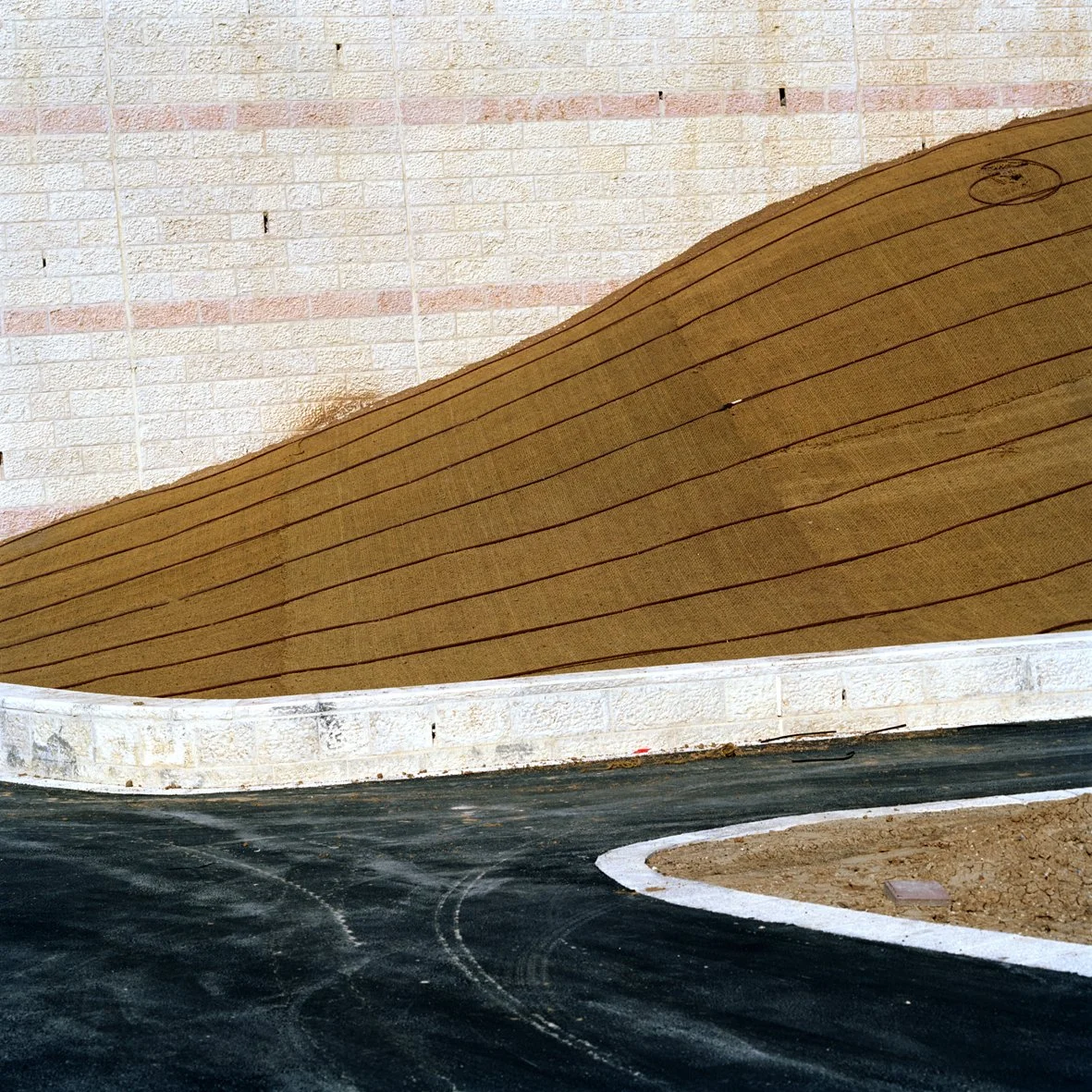
Silva's exhibit Garden State focuses on public and private gardens, which, innocuous though they may seem, reflect a deeper and troubling transformation of land.
Working across photography, moving image, and sculptural installation, Corinne Silva seeks to make visible fractures of historic violence in the land, as well as strategies of survival and resistance in conflict zones. Silva is currently based between London and Athens, and develops work in different ecologies of land and communities. This conversation marks the re-presentation of Silva’s work, Garden State (2015), in Garden Futures: Designing with Landscape at V&A Dundee, on view in Dundee, UK, until January 25, 2026.
JELENA SOFRONIJEVIC: Garden State is an installation of around 100 c-type photographs, taken between 2010 and 2013, of public and private gardens across 22 Israeli settlements. These gardens are situated on land from which Palestinian communities were displaced during the Arab-Israeli War and the formation of Israel (1948), and the Six Day War (1967). How did you come to make this body of work, which was first exhibited a decade ago, and what does it mean to re-present this work in 2025?
CORINNE SILVA: In school history lessons in the north of England where I grew up, I learned about Turnip Townshend and crop rotation in the 1800s. We didn’t learn about the British Empire, about territorial expansion, or how we continue to bear the consequences of that history.
The shaping of land, space, and place has long been central to my artistic practice, and it became important for me to educate myself about how colonialism is enacted in the landscape. I became interested in quieter enactments of violence — less visible, but deeply embedded. And where one might also find resistance: in vernacular architecture, in adaptive forms.
When I began working on Garden State, I learned how the gardens in these occupied lands are both material and symbolic evidence of ongoing settler colonization. Here, gardening and landscaping are tools of power, reinforcing political, social, and cultural ideologies.
I was thinking about how the country I was born in had contributed to these structures — and also about how Palestine, like the American West, has long been represented as an empty space. In the U.S. imaginary, the West is a lawless territory, a space for fulfilling desires. Palestine was presented as a land with no people, a space to be claimed. The land, in both contexts, becomes a screen for settler imaginaries. I slowly developed a visual language that offered a different kind of representation.
I initially visited Palestine/Israel and travelled as widely as I could — throughout the West Bank, into the Negev desert — trying to learn to read the land, guided by people who helped me interpret what I was experiencing. In previous works, I had explored how humans shape landscapes through surface, seam, and repair. Here, where land is taken piece by piece and water diverted from wells and rivers, I focused on public and private gardens in new Israeli developments, known as “New Towns” and “Quality of Life” settlements.
By focusing on individual horticultural arrangements, I was thinking about the cumulative effect of small acts that lead to the transformation of a whole land. These gardens, walls, pathways — they lay over older topographies, [palimpsests] claiming space and often obscuring what came before.
Gardens are micro-landscapes. They might seem innocuous, but collectively they have the capacity to reshape vast territories. They’re not just surfaces — their roots extend underground. They’re impermanent, but they can feel like permanent markers.
As for showing the work now — it’s something I’ve reflected on deeply. I’m glad it’s being shown, and that an institution has taken the decision to present it. At a time when many Western leaders are denying that a genocide is taking place and not commenting on the accelerated expansion of Israeli settlement building in the West Bank since October 7th, it’s crucial for institutions to support work that addresses the structures of this settler colonial project. Especially an institution like the V&A, whose own history and collections are so deeply entwined with empire. They have shown integrity and I value that.